publications
2026
-
 A metabolic model based on a pangenome core reveals putative conserved biochemical features of the phytopathogen Xylella fastidiosaPaola Corbín-Agustí, Miguel Álvarez-Herrera, Miguel Román-Écija, and 4 more authorsMicrobiological Research, 2026
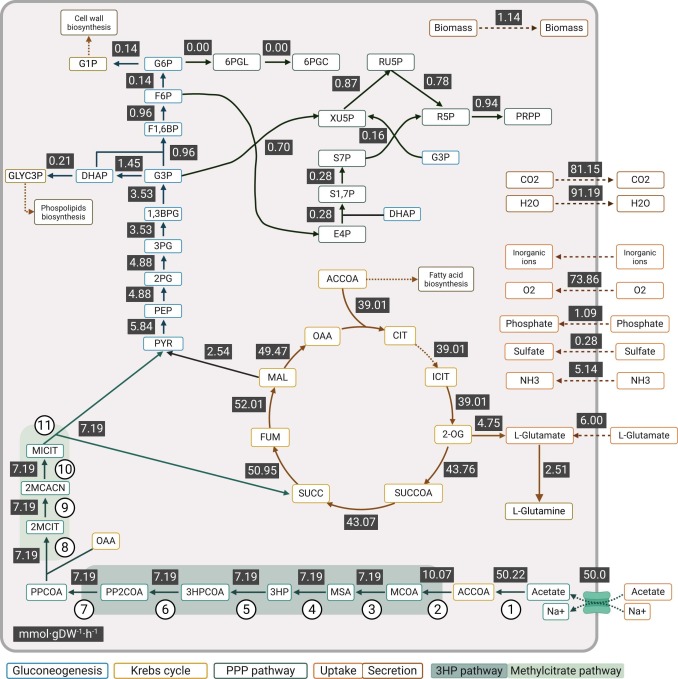
Xylella fastidiosa is a xylem-limited phytopathogenic bacterium responsible for severe diseases in many economically important crops. Despite its impact, its metabolism remains poorly characterized due to fastidious growth and the limited availability of defined culture media. Here, we reconstruct the first pangenome-based genome-scale metabolic model for X. fastidiosa, integrating conserved metabolic functions from 18 strains across five subspecies. The resulting consensus model, iXfcore, is manually curated and used to explore the species’ metabolic capabilities. Model simulations predict minimal nutritional requirements that guide us in the formulation of defined media to assess biofilm formation in vitro, supporting the utility of the resulting predictions. Network analysis also identifies a previously undescribed model-predicted candidate pathway for acetate assimilation, consistent with genomic evidence but requiring further empirical validation. In addition, the model predicts the overproduction of polyamines, compounds linked to virulence in other phytopathogens. Experimental analyses confirm polyamine production in multiple X. fastidiosa strains in vitro, providing the first evidence of polyamine detection in culture supernatants of this phytopathogen. Overall, iXfcore provides a systems-level framework to investigate X. fastidiosa metabolism, generate testable hypotheses on its physiology and putative virulence-associated traits, and support future strain-specific models and studies of host-pathogen metabolic interactions.

2025
-
 Genome data artifacts and functional studies of deletion repair in the BA.1 SARS-CoV-2 spike proteinMiguel Álvarez-Herrera, Paula Ruiz-Rodriguez, Beatriz Navarro-Domínguez, and 9 more authorsVirus Evolution, Mar 2025
Mutations within the N-terminal domain (NTD) of the spike (S) protein are critical for the emergence of successful SARS-CoV-2 viral lineages. The NTD has been repeatedly impacted by deletions, often exhibiting complex and dynamic patterns, such as the recurrent emergence and disappearance of deletions in dominant variants. This study investigates the influence of repair of NTD lineage-defining deletions found in the BA.1 lineage (Omicron variant) on viral success. We performed comparative genomic analyses of more than 10 million SARS-CoV-2 genomes from GISAID to evaluate the detection of viruses lacking S:ΔH69/V70, S:ΔV143/Y145, or both. These findings were contrasted against a screening of publicly available raw sequencing data, revealing substantial discrepancies between data repositories, suggesting that spurious deletion repair observations in GISAID may result from systematic artifacts. Specifically, deletion repair events were approximately an order of magnitude less frequent in the read-run survey. Our results suggest that deletion repair events are rare, isolated events with limited direct influence on SARS-CoV-2 evolution or transmission. Nevertheless, such events could facilitate the emergence of fitness-enhancing mutations. To explore potential drivers of NTD deletion repair patterns, we characterized the viral phenotype of such markers in a surrogate in vitro system. Repair of the S:ΔH69/V70 deletion reduced viral infectivity, while simultaneous repair with S:ΔV143/Y145 led to lower fusogenicity. In contrast, individual S:ΔV143/Y145 repair enhanced both fusogenicity and susceptibility to neutralization by sera from vaccinated individuals. This work underscores the complex genotype-phenotype landscape of the spike NTD in SARS-CoV-2, which impacts viral biology, transmission efficiency, and immune escape potential, offering insights with direct relevance to public health, viral surveillance, and the adaptive mechanisms driving emerging variants.

2024
-
 VIPERA: Viral Intra-Patient Evolution Reporting and AnalysisMiguel Álvarez-Herrera*, Jordi Sevilla*, Paula Ruiz-Rodriguez, and 6 more authorsVirus Evolution, Jan 2024
Viral mutations within patients nurture the adaptive potential of severe acute respiratory syndrome coronavirus 2 (SARS-CoV-2) during chronic infections, which are a potential source of variants of concern. However, there is no integrated framework for the evolutionary analysis of intra-patient SARS-CoV-2 serial samples. Herein, we describe Viral Intra-Patient Evolution Reporting and Analysis (VIPERA), a new software that integrates the evaluation of the intra-patient ancestry of SARS-CoV-2 sequences with the analysis of evolutionary trajectories of serial sequences from the same viral infection. We have validated it using positive and negative control datasets and have successfully applied it to a new case, which revealed population dynamics and evidence of adaptive evolution. VIPERA is available under a free software license at https://github.com/PathoGenOmics-Lab/VIPERA.
